

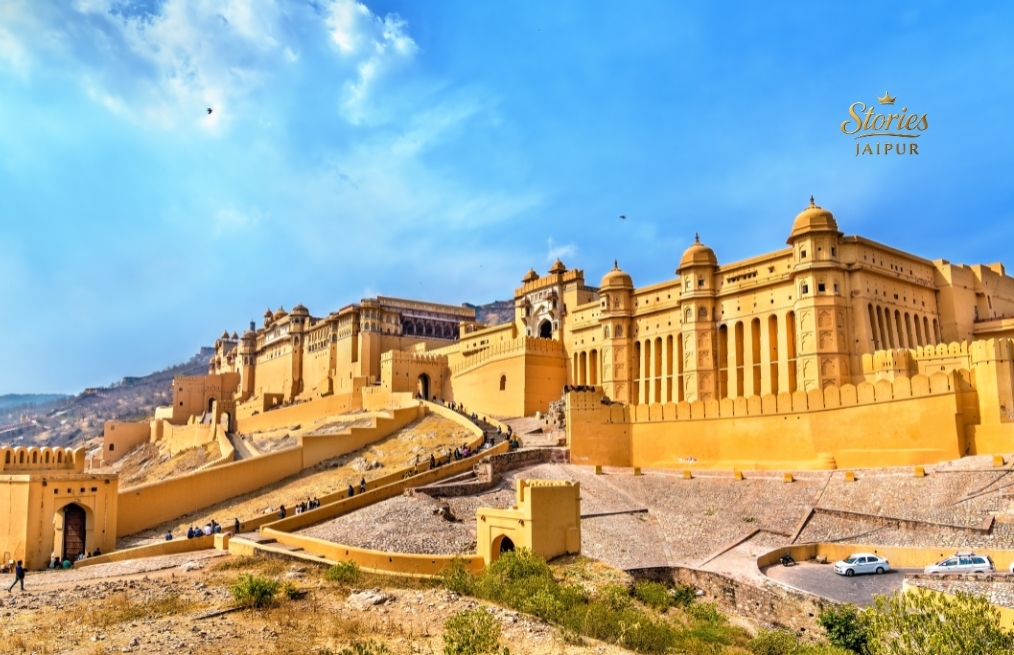
Amer Fort, a magnificent citadel perched atop a rugged hill, stands as a crowning jewel of Jaipur’s rich heritage. This sprawling complex, built with a harmonious blend of red sandstone and white marble, is a testament to the unparalleled grandeur and architectural prowess of the Rajput rulers. More than just a fortress, Amer Fort is a captivating journey through centuries of royal history, offering visitors a profound glimpse into the opulent lives of the Kachwaha Rajputs.
A Fusion of Architectural Styles
The construction of Amer Fort was initiated in 1592 by Raja Man Singh I, a trusted general of the Mughal Emperor Akbar. Successive rulers expanded it over 150 years. This long period of development resulted in a unique architectural fusion, combining elements of both Rajput (Hindu) and Mughal (Islamic) styles. Visitors can marvel at the intricate carvings, exquisite frescoes, and detailed mirror work that adorn the palace walls and ceilings. Each of the fort’s four central courtyards tells a story, showcasing distinct architectural marvels and offering a progression from public to private royal spaces.
Royal Courtyards and Palatial Wonders
Upon entering through the impressive Suraj Pol (Sun Gate), visitors arrive at the Jaleb Chowk, a grand courtyard where royal armies once paraded. From here, a grand stairway leads to the second courtyard, home to the Diwan-i-Aam (Hall of Public Audience). This pillared hall, with its elephant-shaped capitals, served as the king’s assembly where he would address his subjects.
The highlight for many is the third courtyard, accessed through the beautifully adorned Ganesh Pol. This courtyard houses the private quarters of the Maharaja, including the mesmerising Sheesh Mahal (Mirror Palace) or Jai Mandir. Adorned with thousands of tiny, convex mirrors, the Sheesh Mahal creates a dazzling, kaleidoscopic effect when illuminated by a single candle, truly earning its reputation as a “glittering jewel box.” Opposite the Sheesh Mahal lies the Sukh Niwas (Hall of Pleasure), ingeniously designed with water channels to create a naturally cooled environment, a remarkable example of ancient air-conditioning.
The fourth courtyard, the oldest part of the fort, was dedicated to the Zenana (women’s quarters). Here, the Palace of Man Singh features rooms around a central pavilion, where the queens would gather in privacy.
Strategic Location and Enduring Legacy
Amer Fort’s strategic location on the Aravalli hills, overlooking the serene Maota Lake, provided both natural defence and breathtaking panoramic views. A subterranean passage connects Amer Fort to the formidable Jaigarh Fort, serving as an escape route during times of conflict.
Today, Amer Fort is a UNESCO World Heritage Site, drawing thousands of tourists annually. Beyond its architectural splendour, the fort offers a glimpse into the enduring legacy of the Rajput dynasty, their valour, and artistic sophistication. The daily sound and light show, held in the evenings, brings the fort’s history to life, narrating tales of its glorious past and immersing visitors in the vibrant culture of Rajasthan. A visit to Amer Fort is not merely a sightseeing excursion, but a profound experience that invites one to step back in time and witness the majestic journey through Rajput grandeur.
