

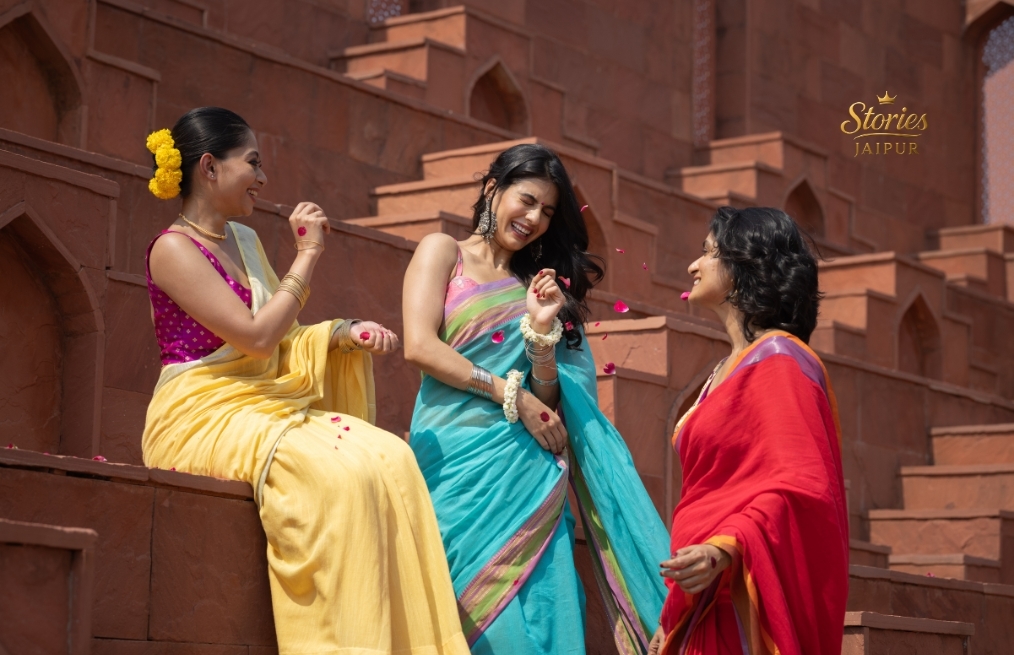
Rajasthan, the land of Maharajas and majestic forts, offers a sartorial journey as rich and diverse as its history. While often associated with the sweeping sands of the Thar Desert, the true essence of Rajasthani fashion lies in its intricate details, regional nuances, and the powerful stories woven into every thread. It’s a legacy of elegance and colour that has evolved over centuries, reflecting not just royal patronage but also the everyday lives and artistic expressions of its people.
Regional Rhythms and Styles
The beauty of Rajasthani fashion is its incredible regional diversity. While core elements remain consistent, each region – be it Marwar, Mewar, Hadoti, or Dhundhar – boasts its unique interpretations. For instance, the poshak of Mewar, a complete set comprising ghagra, choli, odhani, and kanchli, is known for its heavy embroidery and royal motifs. In contrast, Marwari attire often features lighter fabrics and vibrant tie-dye techniques, such as bandhani and leheriya, which are ideally suited for the arid climate. This regional specificity adds layers of depth to the “tapestry” of Rajasthani clothing.
Fabrics: A Symphony of Textures
The choice of fabric is paramount in Rajasthani attire, dictated by both climate and occasion. Cotton, especially fine mulmul, is a staple for daily wear due to its breathability and comfort. For festive occasions and royal garments, silk, brocade, and even velvet come into play, often adorned with metallic threads. The unique Kota Doria fabric, a fine woven material with square checks, originating from Kota, is another prized possession, valued for its lightness and sheer quality. Each fabric tells a story of local weaving traditions and environmental adaptation.
Embellishments: Artistry in Detail
What truly elevates Rajasthani fashion is its extraordinary array of embellishments. Gota patti, a shimmering appliqué technique using metallic ribbons, is a signature style that creates intricate floral and geometric patterns. Zardozi and dabka work, involving delicate metallic wire embroidery, add opulent textures, often seen on royal garments. Mirror work (aari tari) reflects the desert sun, while colourful thread embroidery (resham) brings vibrant life to every garment. These hand-crafted details are not just decorative; they are a testament to generations of skilled artisans.
The Ever-Evolving Turban
The turban, or pagri, is perhaps the most iconic male accessory in Rajasthan, a vibrant symbol of cultural heritage. Its variations are astonishing, with specific styles indicating caste, social status, or even the occasion. The Panchrangi Pagri, a five-colored turban, is a celebratory sight, while simpler, more practical turbans are worn for daily tasks. The art of tying a perfect turban is a skill passed down through families, making each pagri a unique sculptural masterpiece.
Jewellery: A Resplendent Narrative
Rajasthani attire is incomplete without its distinctive jewellery. Women are adorned with a magnificent array of silver and gold ornaments, each with a specific name and significance. From the heavy aad (choker necklace) and borla (forehead ornament) to the intricate hathphool (hand ornament) and payal (anklets), every piece contributes to the overall splendour. Men also wear traditional jewellery, such as murki (earrings) and kadas (bracelets). This jewellery isn’t just about display; it often carries symbolic meaning, reflecting marital status, prosperity, and cultural identity.
A Timeless Allure
Even in contemporary times, Rajasthani fashion continues to be a powerful presence. Designers draw inspiration from its rich heritage, reinterpreting traditional motifs and techniques for modern sensibilities. Beyond the desert’s sandy expanse, the fashion of Rajasthan continues to captivate with its profound history, diverse expressions, and the enduring grandeur of its artistic legacy, truly a remarkable tapestry woven through a millennium.
