

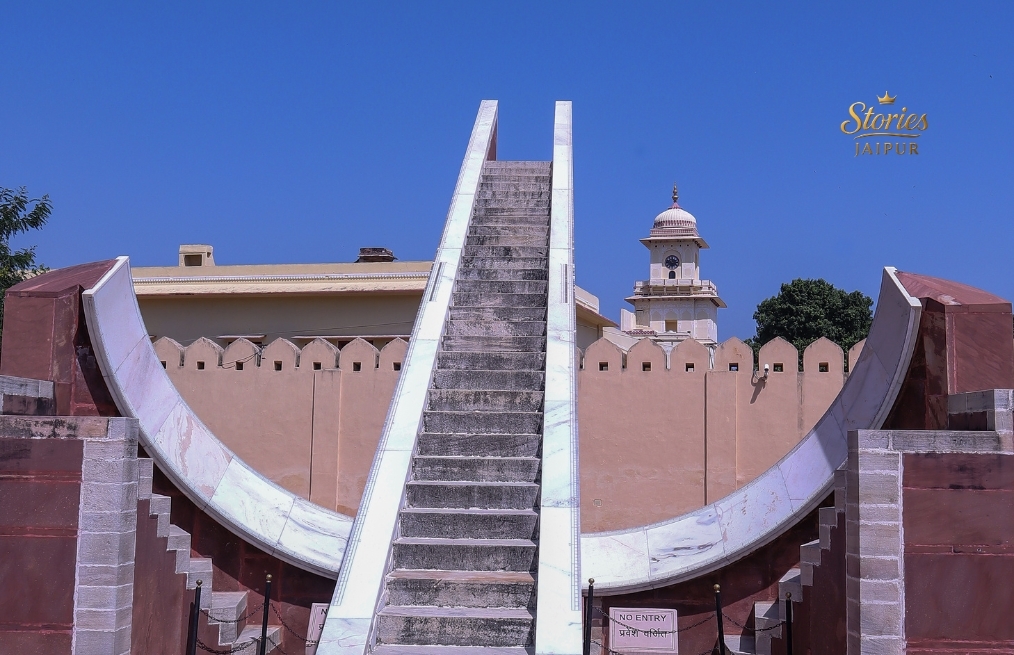
Nestled in the heart of Jaipur, the Jantar Mantar is far more than just a collection of unusual structures; it is an extraordinary testament to the scientific and astronomical prowess of 18th-century India. Built between 1727 and 1734 by Maharaja Sawai Jai Singh II, the founder of Jaipur and a passionate astronomer, this UNESCO World Heritage Site is one of five such observatories he constructed across India. Jantar Mantar, which translates to “calculation instrument,” served as a crucial hub for studying celestial movements, predicting eclipses, and accurately measuring time. It stands today as a profound symbol of a bygone era when rulers actively championed scientific inquiry.
A Royal Vision for Astronomical Precision
Maharaja Sawai Jai Singh II was not just a great ruler but also a dedicated scholar of astronomy, well-versed in both Indian and foreign astronomical texts. He recognised the inaccuracies of the then-available astronomical tables and sought to create a more precise and accurate system for celestial observations. His vision led to the construction of these remarkable observatories, with the one in Jaipur being the largest and best preserved. The instruments at Jantar Mantar are monumental in scale, designed to achieve higher accuracy by minimising human error and optical distortions inherent in smaller instruments.
Monumental Instruments for Celestial Studies
The Jantar Mantar in Jaipur comprises a collection of nineteen large-scale astronomical instruments, each with a specific purpose. These fixed instruments are built from stone and marble, meticulously calibrated to align with the Earth’s axis and celestial poles. Among the most prominent are:
- Samrat Yantra (The Supreme Instrument): This colossal sundial, standing nearly 90 feet tall, is the world’s largest. Its gnomon (the triangular wall) is aligned with the Earth’s axis, and its shadow accurately measures time to within two seconds, making it an astonishingly precise timekeeping device.
- Jai Prakash Yantra: Consisting of two hemispherical bowls, this instrument maps celestial positions. Observers would stand inside the bowls, aligning grids with stars as they passed overhead, providing a tangible way to understand celestial coordinates.
- Rama Yantra: Two cylindrical structures with open tops, used to measure the altitude and azimuth of celestial objects, crucial for pinpointing their exact positions.
- Mishra Yantra: A composite instrument capable of determining the shortest day of the year, the longest day, and also the precise noon in various cities across the globe.
Each instrument is a masterpiece, reflecting a profound understanding of spherical trigonometry and celestial mechanics.
Bridging Ancient Wisdom and Modern Science
The Jantar Mantar represents a remarkable confluence of ancient Indian astronomical wisdom and advancements from other cultures, including Islamic and European astronomy. Jai Singh II not only drew upon existing knowledge but also innovated, creating new instruments and improving upon old designs. The observatory served as a vibrant centre for astronomical research, facilitating the compilation of new astronomical tables (known as the Zij-i Muhammad Shahi) and aiding in calendar reform.
Today, Jantar Mantar continues to fascinate scientists, historians, and tourists alike. It serves as an educational tool, demonstrating the principles of timekeeping, celestial navigation, and the movements of planets and stars in a tangible, awe-inspiring manner. A visit to this extraordinary site is not just a walk through history but a journey into the remarkable mind of a visionary ruler who dared to unravel the secrets of the cosmos, leaving behind a legacy of scientific inquiry that continues to inspire.
